

Vice President Sales Central & Eastern Europe
Michael Krause heads up sales for Central and Eastern Europe at ASC. With over 18 years of experience, he combines strategic thinking with practical advice to support customers in implementing modern compliance and recording solutions.
What Does "Voice of the Customer" (VoC) Mean?

In short, the "Voice of the Customer" (VoC) describes the voice of the customer – in other words, everything customers think, say, and feel about a product or service. This includes customer feedback, reviews, complaints, and praise.
But the voice of the customer is much more than just feedback: it is a form of active, data-based market research that reflects the customer's perspective directly from real communication situations – beyond traditional surveys or selective reviews.
Companies that actively record and analyze their customer interactions gain a deeper understanding of customer satisfaction, customer wishes, and customer experiences. Systematic analysis of the VOC reveals patterns and trends that go beyond pure focus groups or the Net Promoter Score (NPS).
With modern customer experience analytics and AI-powered tools such as Recording Insights for Microsoft Teams, the voice of the customer becomes a real competitive factor: AI and natural language processing (NLP) transform conversation data into actionable VoC data that helps companies optimize the customer experience and customer journey in a targeted manner.
How Companies Holistically Capture and Evaluate VOC
To understand the voice of the customer, companies use various methods of customer data collection. These include traditional surveys, focus groups, the Net Promoter Score (NPS), and social media monitoring. These tools provide valuable insights, but often only at specific points in time – snapshots that rarely show the complete picture.
Customer service generates huge amounts of communication data every day that reveal far more about customer expectations, satisfaction, and product perception than any survey results. With omnichannel recording and the systematic capture of all customer interactions – voice, video, chat, shared content, and email communication – companies can create a holistic data foundation. This reflects what really matters to customers and enables the quantitative collection of customer feedback across all channels.
AI-based solutions such as Recording Insights go one step further: they analyze communication qualitatively – automatically, objectively, and in real time. The software transcribes customer conversations, recognizes moods and emotions through sentiment analysis, and interprets content using natural language understanding. This turns millions of conversation fragments into precise insights into the target group, customer needs, customer experience, and trends that remain hidden in conventional analyses.
Use Cases: How AI Analytics Translates the Voice of the Customer into Measurable Results
AI-supported analytics and the evaluation of all communication data from voice, video, chat, and email result in concrete recommendations for action in various areas of the company.
Increase customer satisfaction in real time
The contact center is where VOC can be measured on a daily basis. This is where customers decide how they perceive a company and whether they are satisfied. Through the use of AI-based customer experience management in customer support, these interactions can now not only be recorded, but also understood and specifically controlled in real time.
Recording Insights analyzes all customer communications across channels—voice, video, chat, or shared content—and delivers immediately actionable data. With speech analytics and natural language understanding, the software recognizes when a conversation is going well or when support is needed. This allows supervisors to intervene in a targeted manner, coach employees in real time, and immediately improve service quality.
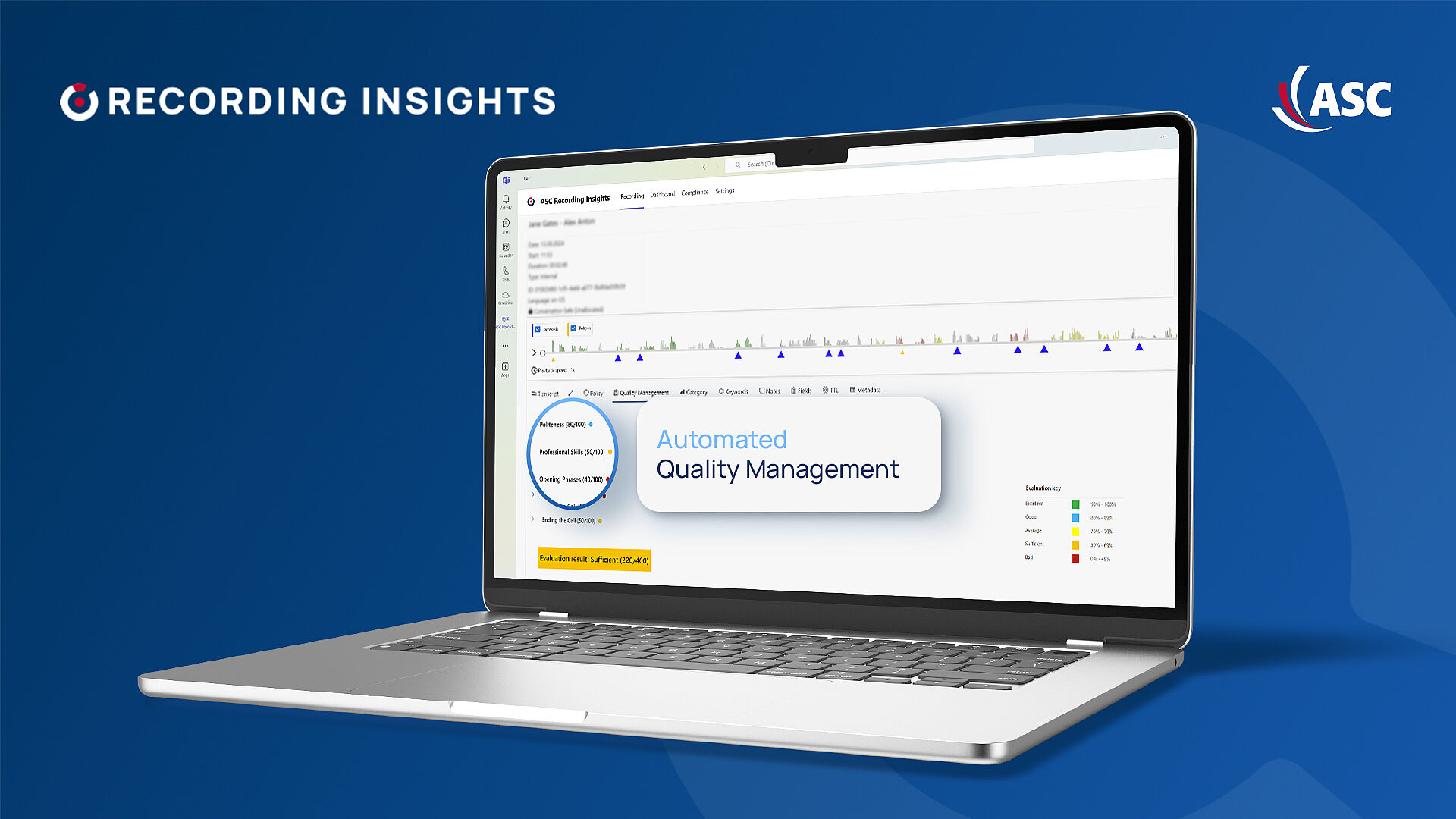
Quality assurance also benefits: AI automatically evaluates whether conversation guidelines have been followed, identifies training needs, and reduces the effort required for manual checks. Supervisors immediately recognize deviations, can intervene in a targeted manner, and thus avoid escalations. This reduces post-processing times, improves the first-call resolution rate, and increases customer satisfaction in the long term.
A more in-depth look at how this works in practice can be found in the article "AI in customer service – real-time support & analytics," which shows how Recording Insights supports contact centers in terms of quality, efficiency, and customer satisfaction.
Increase Sales Opportunities Along the Customer Journey and Improve Customer Experiences
In sales, analyzing the voice of the customer provides valuable insights into how customers talk about a product or service – which arguments are convincing, where objections exist, and which expectations remain unfulfilled. Every customer interaction thus becomes a source of usable data that flows directly into the sales process.
Using AI-supported speech analysis, Recording Insights recognizes when interest arises, when willingness to buy is signaled, or when skepticism prevails. These insights help sales staff to tailor customer experiences, proactively address objections, and customize the dialogue.
Sales managers also benefit from the evaluation of aggregated data: they can see which topics or products are mentioned regularly, where obstacles arise in the sales process, and which communication strategies lead to higher closing rates.
In this way, the voice of the customer becomes a tool that increases sales opportunities, strengthens customer loyalty, and makes the impact of sales strategies measurable. Companies can identify changing market needs more quickly and develop their products and services accordingly.
Translating customer needs into innovation
The analysis provides product teams with direct information about which functions, features, or services customers really value—and where there are gaps. While traditional market research often only asks about hypothetical wishes, the evaluation of real customer dialogues shows which requirements actually matter in everyday life.
With Recording Insights, developers and product managers can consolidate communication data from sales, support, and social channels. This provides consistent insights into customer needs – from frequently mentioned problems to unexpected usage scenarios.
These insights flow directly into the product strategy: functions are prioritized, weaknesses are identified early on, and products or services are adapted more quickly to market changes. At the same time, the link to customer experience analytics makes it possible to measure the success of new features – based on real customer reactions, not just internal assumptions.
The result: shorter development cycles, lower risk in market launches, and a noticeable increase in customer satisfaction and loyalty.
Understanding target groups and refining communication
For marketing, the voice of the customer is a direct gateway to the perception of the target group. Instead of relying on surveys or assumptions, AI-supported analysis provides continuous insights into real customer experiences – from conversations, chats, reviews, or support requests.
Recording Insights gives marketing teams precise insights into customer needs and expectations. The software reveals recurring themes, sentiments, and trends that show how products or services are actually experienced. Based on this, messages, campaigns, and content can be tailored to better reach target groups emotionally and in terms of content.
This also creates measurable added value for product communication: for example, if the AI recognizes that customers particularly appreciate certain product features or frequently ask about them, marketing can emphasize these aspects more strongly – and at the same time respond to negative perceptions at an early stage.
In this way, the voice of the customer helps to better understand customers, optimize marketing strategies, use budgets more efficiently, and be more successful than the competition. Companies gain a realistic picture of their target group – not from random samples, but from millions of real customer voices.
Decisions based on real customer experiences
For executives, the voice of the customer is a management tool for market analysis and performance measurement. It condenses unstructured communication data into clear metrics on customer satisfaction, customer experience (CX), and ROI. Instead of relying on surveys or individual reports, decisions are based on what customers actually experience and express.
Recording Insights gives management teams a complete overview of all customer interactions—across voice, video, chat, and email. The integrated analytics dashboards present this information in a single pane of glass: all relevant data points, trends, and sentiments in one central location. Executives no longer have to switch between systems or manually merge reports—they can see in real time how customer experience, service quality, and customer loyalty are developing.
This transparency enables fact-based prioritization: management can make targeted investments where they have the greatest impact on revenue, efficiency, or brand perception . Early detection of trends helps to further develop products and services and secure long-term market position.
The Voice of the Customer as a Strategic Compass
The voice of the customer has long been more than just a tool for measuring customer experiences and quality management. It is a continuous stream of data that shows what customers really think, feel, and expect—and thus becomes a central control instrument for the entire organization.
With solutions such as Recording Insights, all communication channels – from voice to video to chat – can be captured and analyzed in a single platform. AI-powered analytics transform unstructured conversations into clear recommendations for action that measurably improve customer experience, service quality, and product development.
This creates a new form of transparency, especially for managers: a single pane of glass that visualizes all VoC data in real time and puts decisions on a solid, fact-based foundation.
Companies that understand and actively use their voice of customer not only respond more quickly to customer needs—they also help shape markets.