When existing recording platforms, product strategies or support models change, the choice is broader than picking a like-for-like successor. ASC migrates your existing recordings and historical communication data to a modern communications compliance platform for recording, archiving and Agentic AI.

The reasons for changing platforms differ from one organization to another. In regulated industries, operational, technical and strategic factors often come together.
Acquisitions, portfolio consolidation or strategic realignment can prompt organizations to reassess their existing recording and compliance architecture and evaluate whether it still meets current requirements.
When support models or contracts end, historical communication data still needs to remain securely available and traceable, without the need to operate multiple legacy systems in parallel.
Regulatory requirements extend beyond recording. Communication must be captured, securely retained and centrally available for transparent analysis, investigations and regulatory review when needed.
Telephony, meetings, chat, video and mobile messaging generate growing volumes of relevant communication data that need to be captured, retained and made centrally available.
The biggest challenge in a platform change is often not the new environment, but the existing data. ASC has extensive experience transferring large volumes of historical communication data.
When introducing Microsoft Teams, DZ BANK replaced an existing third-party recording solution. The contract for the legacy system had already ended, and the migration was tied to a fixed deadline.
Using the History Vault approach developed for this project, ASC transferred the complete historical data set to the new environment on time, without long-term parallel operation.
The historical communication data is subsequently available centrally in the ASC environment and can continue to support compliance-related processes.
Replacing an existing platform should not be limited to feature parity. A platform change creates the opportunity to bring recording, archiving and intelligent analysis together on one platform.
We review communication channels, integrations, existing data, retention requirements and operational priorities.
Based on this assessment, we develop an approach covering architecture, timeline, responsibilities and data migration.
Recordings, metadata and relevant retention information are transferred to the new environment through a controlled process. Access to historical communication is maintained throughout the transition.
After successful validation, the existing system can be decommissioned in a controlled manner. The platform can then be expanded with additional communication channels and AI-powered analysis capabilities.
What does replacing a communications compliance platform actually involve, what happens to historical data, and how do you recognize the right moment? Our specialists walk through the process using a real migration project and answer your questions directly.
15 October 2026 · 09:00 CEST · 20 minutes · online · held in English
Can't attend? Register anyway and we will send you the recording.
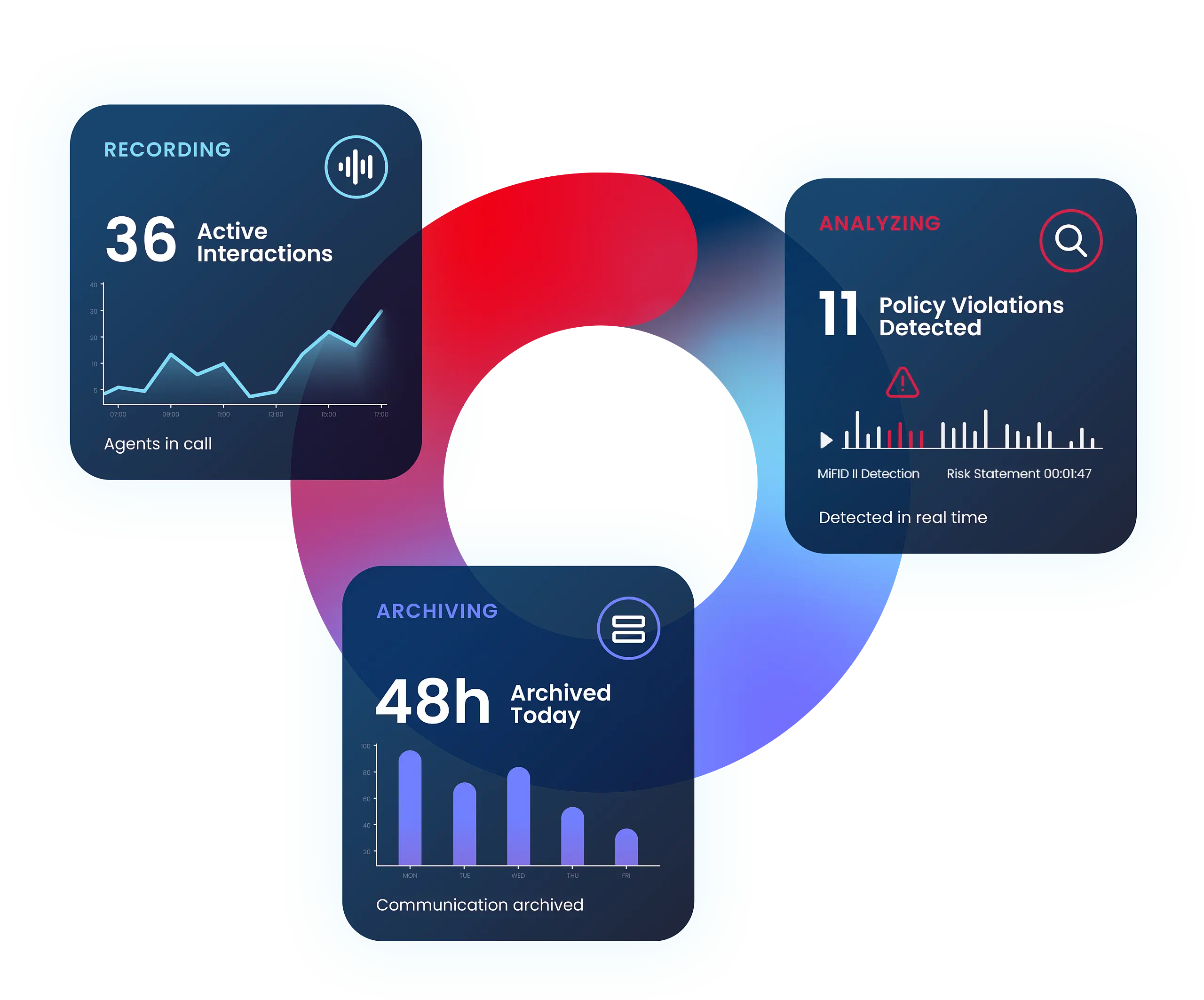
ASC focuses on capturing, retaining and intelligently analyzing business-relevant communication.
Recording, archiving and Agentic AI work together on one platform.
Deep integration with Microsoft Teams and Azure, for modern Microsoft-based communication environments.
ASC is built for cloud operation: rapid deployment and no hardware refresh cycles. Where regulatory or organizational requirements call for it, on-premises and hybrid models are available.
A SaaS model with predictable costs, shorter implementation projects and less IT effort than classic recording architectures.
Support from the initial assessment through migration to the continued development of your environment.
Existing recordings can be migrated to the new ASC environment and remain centrally available. In the DZ BANK project, this included approximately 140 million recordings spanning 13 years.
Indefinite parallel operation is neither the objective nor, as a rule, necessary. Once the migrated data has been validated, the existing system is decommissioned in a controlled manner. How long a transition phase takes depends on data volume and the current environment. In the DZ BANK project, no long-term parallel operation was required.
This depends in particular on data volume, data structure and the existing infrastructure. For scale, approximately 140 million recordings were transferred within a matter of weeks in the DZ BANK project.
Retention information is transferred together with the recordings, so that existing retention periods continue to apply. Which data and metadata are relevant is defined during the initial assessment and in the migration concept.
Recording can be the starting point. The value of a communications compliance platform becomes particularly clear when additional channels, archiving requirements or AI-powered analysis are added. The technological foundation is already in place.
A Migration Assessment can help you evaluate your data estate, technical dependencies and potential project effort well before a migration becomes urgent.
Every communications environment is different. Our specialists work with you to assess your existing platform, historical data and future requirements.