

Director Product Management
Ralf Rösel is Director Product Management at ASC. He is responsible for the alignment and further development of ASC’s entire product portfolio based on market evolution, customer requirements, and new legal regulations in ASC’s target markets.
When modern AI requirements meet classic archive structures
An investigation is initiated. All conversations involving a specific trader over the past 48 hours are needed. The recordings exist — revision-proof, fully documented.
But the path to the answer is still often manual: define time ranges, set search filters, export results, and review relevant conversations.
Compliance archives were built to store communication securely, make it auditable, and fulfill regulatory requirements. Direct access by AI agents was rarely part of the design.
The result is a structural gap: the data exists, but controlled AI access does not.
How an MCP server connects AI with compliance data
This is exactly what the Model Context Protocol (MCP) was developed for. The Model Context Protocol (MCP) is an open standard that defines how AI agents can access external data sources. Instead of building individual interfaces for every application, MCP creates a unified architecture.
An MCP server implements this standard. It acts as an intermediary between the AI agent and the underlying data — controlled, traceable, and within defined access rights.
For compliance applications, this means AI agents can access communication data directly, without creating new permission paths or modifying existing security architectures. The MCP server is the missing link between the AI agent and the compliance archive.
ASC is the first provider in the compliance recording space with a native MCP server — already listed in Microsoft Foundry.
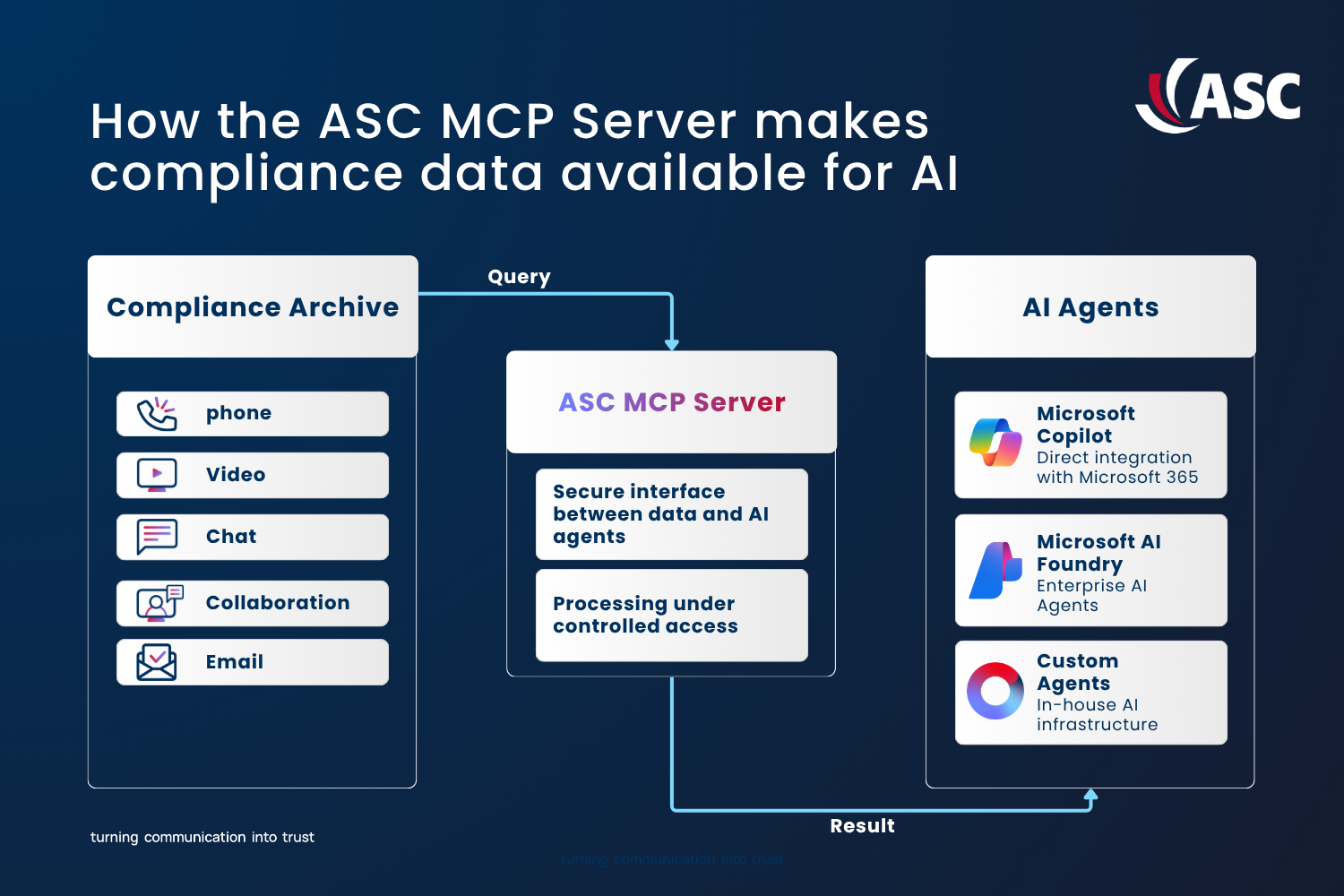
How the ASC MCP server works in practice
The following three scenarios show how the MCP server concretely transforms compliance processes in financial services:
Use Case
Compliance investigation
"Show me all conversations with Trader X from the last 48 hours."
The agent processes the request via the MCP server and delivers the relevant recordings within seconds. What previously required manual filtering comes down to a single prompt. Before: manual search in the archive, filter configuration, export, review. Depending on conversation volume, this is a process that takes hours.
With the ASC MCP Server: The AI agent processes the request, accesses the compliance archive via the MCP server, and delivers the relevant recordings within seconds — fully within the role-based access rights of the requesting user. What previously required manual filtering comes down to a single prompt.
Use Case
Quality review
"Show me all recordings between 5 and 10 minutes from the last week."
Before: Quality reviewers open the archive, manually define filters for time range and call duration, export the result list, and review conversations in a separate tool. With high call volumes, this is a process that consumes hours — and must be repeated regularly.
With the ASC MCP Server: The AI agent receives the request, filters by time range and call duration in the background, and returns the results directly within the agent — no system switching, no manual export. Quality reviewers work in a single interface instead of jumping between multiple tools.
This saves time, but more importantly it improves consistency. Fewer system switches mean fewer errors in selecting and documenting reviewed conversations.
Use Case
Transcript access
"Show me all recordings from 9 February 2026, including transcripts."
Before: Managers and compliance officers depend on a manual detour through the archive — select a date, load conversations, retrieve or generate transcripts separately. Getting a quick overview of communication on a specific day requires disproportionate effort.
With the ASC MCP Server: The AI agent retrieves the relevant recordings directly and presents date, call duration, and transcripts in a structured overview — no media break, no waiting for transcript exports. Decision-relevant information is available within seconds.
This is particularly valuable when speed matters: in response to ad-hoc requests from regulators, during internal escalations, or as part of regular management reviews.
Secure AI access without new permission paths
The key distinction: the ASC MCP Server does not expand any existing permissions. Every AI access runs exclusively within the existing role-based access control (RBAC). An AI agent can only access data the respective user is already authorized to see — nothing more.
This is not a technical given. Many AI integrations require elevated system access or new API permissions that can destabilize existing security architectures. The MCP approach closes this gap structurally.
The integration supports MiFID II, MAR, the EU AI Act, and GDPR.
Requirements for a modern MCP strategy
Organizations looking to deploy AI agents for compliance processes should keep four criteria at the center:
Microsoft Foundry is an AI platform that enables organizations to develop, customize, and deploy their own AI models and applications based on Microsoft infrastructure and tools. The ASC MCP Server is listed in Microsoft Foundry and can therefore be integrated directly into that environment.
Communication data (phone recordings, video conferences, chat logs) contains the information most relevant to compliance investigations. Without structured access to this data, the potential of AI agents in compliance processes remains untapped. The MCP server provides this access without compromising security architectures.
Access is granted exclusively within the framework of the existing role-based access control system. AI agents can only access data that the respective user is authorized to access. All access events can be fully documented and audited. This is a fundamental requirement for regulated industries such as the financial sector.
MCP server compliance is not a future scenario
Organizations that build a controlled MCP infrastructure now create the foundation for compliance processes that can keep pace with the speed of regulatory and technological change. Those that wait will find it difficult to close the gap.
The ASC MCP Server is available as a native component of the ASC platform — listed in Microsoft Foundry, built for the regulatory requirements of European markets.